The Journey Continues
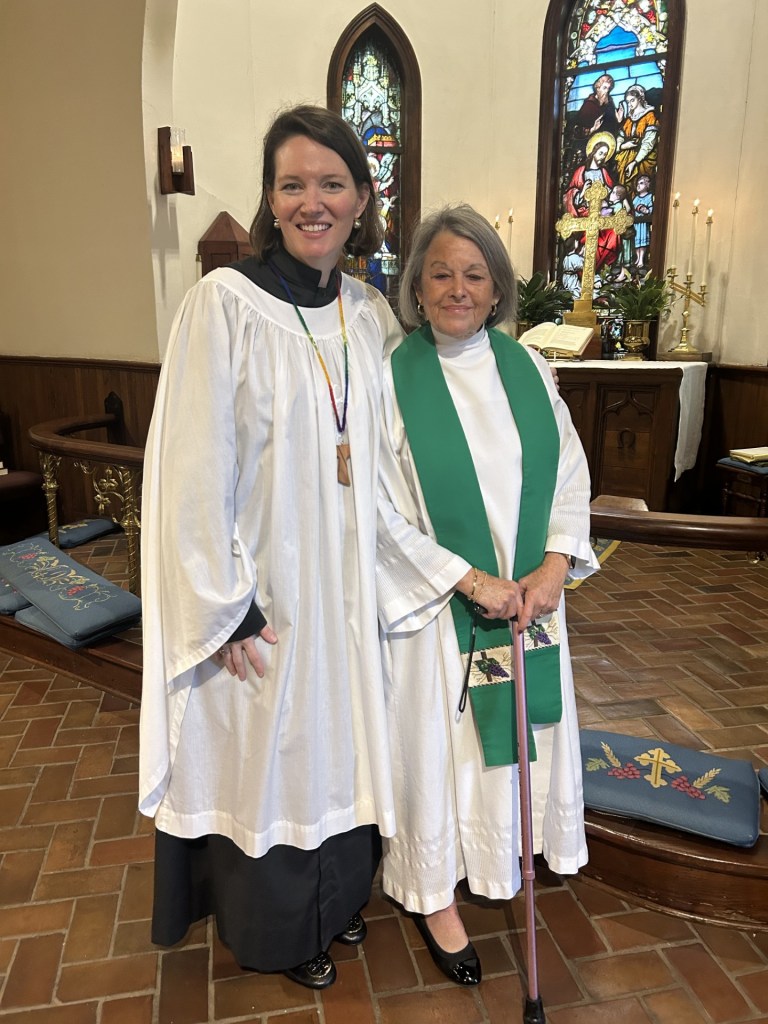
A few weeks ago, a photograph arrived that has stayed with me. It was taken after a midweek Eucharist at Christ Church, Greenville, South Carolina. In it, Peggy Muncie, MDiv ’74, stands vested at the altar. Beside her, also vested, is Kristin Bennett, a seminarian in Cohort 4 of our hybrid MDiv program, serving as her lay assistant. The altar glows softly behind them.
There is nothing grand about the setting — no cathedral crowd, no institutional ceremony. Just a weekday Eucharist attended by twenty or so faithful parishioners. And yet the image felt luminous. It was not simply a picture of two women at the altar. It was a picture of time itself — of courage received and courage renewed.
Peggy arrived on the Close in September 1971, just after General Convention had authorized the ordination of women to the diaconate. When she walked into her first Old Testament class, she remembers the room being full — more than forty students — and feeling the weight of being one of only a handful of women. In the refectory, few spoke to her. The change was new. Its fruits had not yet appeared.
And yet the faculty, she recalls, were remarkably supportive. Boyce Bennett encouraged her intellectual curiosity and later nominated her for an archaeological dig in Israel — an experience that widened her theological imagination and grounded her in the living soil of Scripture. Richard Corney became a long-term mentor. There were moments of resistance, yes, but also moments of affirmation: the first exam returned with an A; comprehensive exams passed; quiet words from professors who treated her vocation seriously.
She lived in Eigenbrodt among classmates who would go on to shape the Church in very different ways. Among the students on the Close in those years was Gene Robinson, then several years ahead of her — another figure whose ministry would eventually stand at the center of ecclesial transformation. History sometimes gathers such lives together long before anyone realizes what is unfolding.
Peggy’s ministry would span parish work, chaplaincy, counseling leadership, and decades of faithful service. She also served for many years on the Alumnae Executive Committee and was Alumnae President in 1996. Few people have witnessed the Seminary’s journey from the late twentieth century into the twenty-first as closely as she has — and that long view has given her both amazement and joy. She also served as a trustee of the Seminary, helping guide General through seasons of financial strain and institutional risk. When the proposal for a hybrid MDiv program came before the Board in 2021, Peggy was among those who voted in favor. She understood something about the cost of innovation — and its necessity. A year later, she supported the affiliation agreement that secured our partnership with Virginia Theological Seminary, recognizing again that institutions, like clergy, do not thrive in isolation. Sustainability, too, can be an act of faith.
Kristin’s story begins in a very different register.
In 2024, while on pilgrimage in partnership with Virginia Theological Seminary and Christ Church, Greenville — her home parish and employer — she found herself in Oxford having coffee with Ian Markham. The group, a mix of Christ Church parishioners, VTS alumni, and trustees, was led by Barney Hawkins and Ian Markham. She was in discernment, wrestling with how seminary might possibly fit into a life rooted in Greenville — with family, vocation, and parish commitments that could not simply be set aside. Over that coffee, she learned more about General’s hybrid MDiv program. That evening, back in her hotel room, she began her application. She has described it as feeling like an answer to prayer.
Her bishop was initially hesitant about the model. Could formation truly happen this way? Could community be sustained at a distance? Kristin persisted. Now, only a few semesters in, she speaks of daily contact with classmates across time zones — sharing drafts, debating texts, praying for one another. The medium is different from 1971. The formation is not.
When the two women met for lunch before Kristin’s matriculation, they spoke for more than two hours. They compared discernment processes then and now; bishops supportive and skeptical; the steadying presence of mentors; the enduring challenge of preaching difficult texts. And when I asked Kristin what she would want Peggy to know, she said simply: “I stand here because of where you stood.”
That sentence contains more than gratitude. It reveals how Christian tradition actually lives.
In the Gospel of John, Jesus speaks of himself as the vine and his followers as branches that bear fruit over time. The life of the Church does not move forward by severing itself from its roots, nor by clinging to them in fear. It grows. It stretches. It sends out new shoots in response to new conditions, drawing from the same sustaining source.
Fifty years ago, a woman’s presence in the classroom and at the altar was contested ground. Today, in a parish chapel in Greenville, it is simply faithful ministry. A hybrid MDiv program — once an experiment — is now forming clergy who might otherwise never have been able to answer their call. The Seminary’s future has always depended on alumni who loved it enough to risk its renewal. An institutional partnership with Virginia Theological Seminary has strengthened that work, allowing General to focus on its primary vocation: theological formation for the sake of the Church.
The Church has not lost itself. It has grown — sometimes painfully, often imperfectly, but always sustained by the same Spirit who first called it into being.
In that small weekday Eucharist, there was no rhetoric about sustainability or innovation. There was simply bread broken and wine poured. Yet embedded in that act were decades of discernment, resistance, courage, partnership, and prayer.
“The journey continues,” Peggy said.
And in the quiet continuity between 1971 and 2025 — between classroom and chapel, between risk and fruit — the life of Christ continues to take root and bear fruit among us.
 Site Title
Leave a comment